
AI Was Never Coming for Your Job. It Was Coming for Your Ceiling.
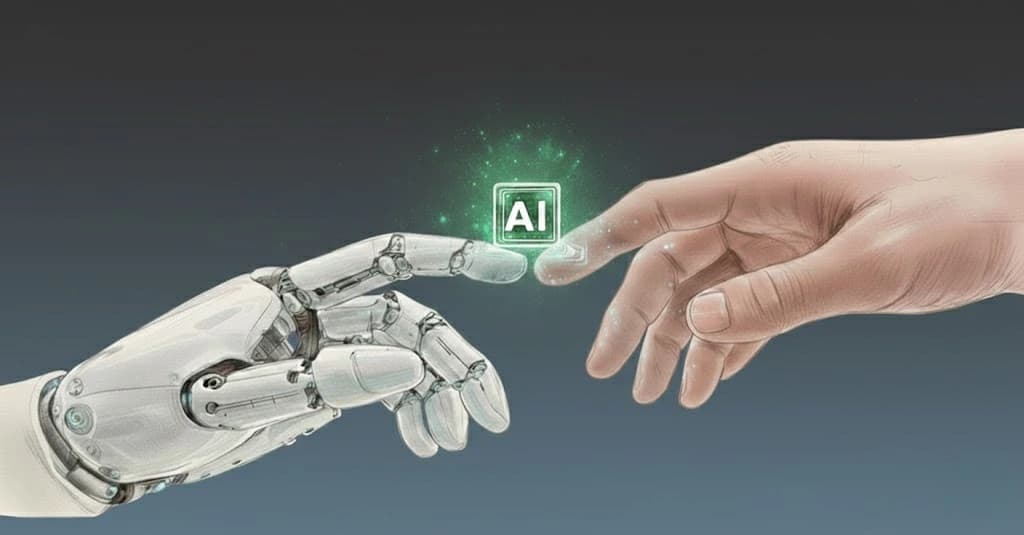
Most companies asked the wrong question about AI. The ones winning aren't using it to replace people. They're using it to make their best people 10x more powerful.
The wrong question, asked confidently
The debate about AI replacing humans missed the point from the beginning.
It was the wrong question, asked by people who saw AI as a workforce calculator. Input humans, output cost savings. Replace where possible. Automate the rest.
That framing is not just wrong. It is strategically dangerous for any organization that adopts it.
Here's what we've learned building AI systems inside real businesses: the organizations that treat AI as a replacement tool get marginal efficiency gains and significant human friction. The organizations that treat AI as an augmentation layer, a system that makes their people sharper, faster, and better-informed, compound.
The difference isn't the technology. It's the belief system underneath it.
What the research actually says
The replacement narrative is loud. The data is quieter, and it points the other way.
Augmentation is where the measured gains live
- Customer support agents using generative AI resolved 14% more issues per hour on average, with novice and lower-skilled workers improving by 34%.
- Consultants using AI completed 12% more tasks, finished 25% faster, and produced 40% higher quality output on knowledge work.
- Developers using GitHub Copilot completed coding tasks 55% faster than the control group.
Notice the pattern. None of these numbers come from removing the human. They come from putting a sharp tool next to a capable person and watching their ceiling move.
The same studies show another pattern that matters more: the largest gains go to the people closest to the work, not the most senior. AI does not flatten expertise. It lifts the floor under it.
The Superhuman Thesis
A bank officer who manually reviews 30 applications a day, with AI-assisted risk scoring, can review 300, with better judgment on each one. They didn't get replaced. They got a 10x operating surface.
A 2-person agency competing against 50-person, with an AI proposal engine built around their actual portfolio, ships personalized bids in 10 seconds. They don't need to hire. They need to think better, and the system thinks with them.
That second example isn't hypothetical. We built it.
What changed when augmentation replaced templates
- Proposal turnaround: 15 minutes to 10 seconds per bid.
- Daily proposal capacity: 4 to 67, from the same 2-person team.
- Client read rate: 22% to 77% (3.5x).
- Proposals that started a conversation: 12% to 39% (3.3x).
No one was replaced. No headcount was added. The system didn't write better than the founders. It retrieved the right evidence from their real portfolio fast enough that the founders' judgment could actually reach the buyer in time to matter.
Read the full breakdown: How a 2-Person Agency Outsmarts 50 Competitors in Minutes.
This is not automation. This is augmentation. The human is still the irreplaceable variable, the one who knows the client, reads the room, makes the call the data can't make. AI removes the ceiling on how much of that human capacity can actually be deployed.
What AI cannot do
The research is just as clear on the other side. The same Harvard and BCG study found a "jagged frontier": tasks that look similar to the human eye produce dramatically different AI quality, and consultants who trusted AI on the wrong side of that frontier performed worse than the control group. Capability and confidence are not the same thing.
In practice, that frontier shows up as:
- AI cannot understand what a client actually meant when they said the project "felt off."
- AI cannot build trust in a room.
- AI cannot make the judgment call that requires 12 years of domain experience compressed into 30 seconds.
- AI cannot sense when a workflow looks right on paper but will break in the third week of deployment.
These are not small gaps. These are the gaps where businesses are won and lost. Every high-value engagement we've run has a moment where the human in the room made a call no model could have made, and that call was what made the outcome stick.
The real risk
The real risk of AI is not that it replaces humans.
The real risk is that organizations use it as an excuse to stop developing humans, to stop investing in judgment, training, craft, and institutional knowledge, because the tool seems to be covering for it.
That is where companies quietly hollow out. The output looks the same for 18 months. Then it doesn't.
This is also why guardrails matter. Not as a bureaucratic layer, but as a design principle. AI needs boundaries: defined by humans, reviewed by humans, adjusted by humans. The moment an organization stops actively shaping how their AI systems behave, those systems stop reflecting the organization's judgment and start replacing it. That is the line you cannot cross without consequences.
Generic AI loses in competitive markets because it generates plausible language, not verifiable proof. Buyers don't convert on language. They convert on evidence. The system that wins is the one that puts the right evidence in front of the right person, fast enough to matter.
What we're building
At Inventokit, our thesis is simple: Human + AI is not a feature. It is the only architecture that compounds.
We build systems designed to make the humans inside an organization more powerful, not redundant. We measure success not by what the system can do alone, but by what the person using it can now do that they couldn't before.
Pakistan has a generation of engineers who are sharp, technically capable, and hungry to prove themselves on the global stage. We are training and deploying that talent into this exact model: engineers who understand AI not as a threat to their value but as a multiplier of it.
The future doesn't belong to AI.
It belongs to the humans who learned to think alongside it.
If you're building an organization where humans and AI compound together, not compete, we should talk.
Part of Inventokit's Thinking series — what we see, what we believe, and what we've learned.